


What are mobile video ads?
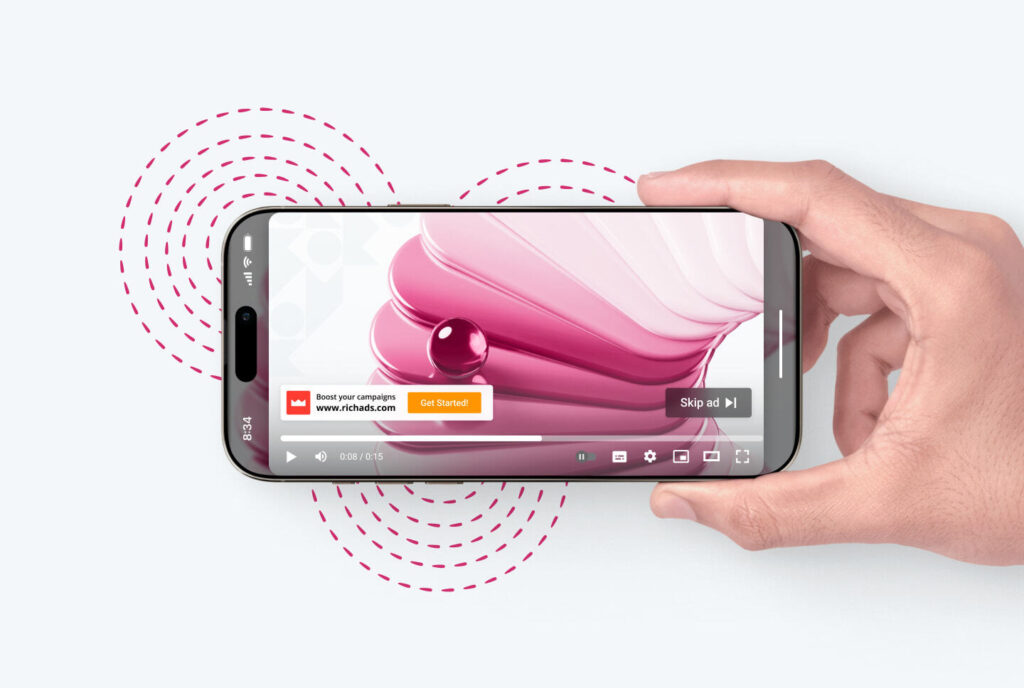
Mobile video ads are video creatives shown specifically on smartphones and tablets — inside apps, mobile browsers, games, and mobile versions of streaming and social platforms. They differ significantly from desktop video ads because user behavior differs.
The key idea behind mobile-first video ads is that they’re built specifically for how people use their phones. Think about how you use your phone: you do everything with one hand, your attention is in a million places simultaneously, you scroll constantly, and you expect short, easy-to-digest content. Video ads should fit these requirements to succeed.
Mobile video ads vs. other formats
Mobile video ads are not just resized versions of regular ads; they work in a completely different way. The design, length, sound, and even the placement of the CTA button on the screen should be tailored for mobile devices.
What aspects to think about:
- Screen and orientation. Desktop ads are built for landscape, wide screens. Video ads for mobile apps need to work vertically (9:16) or in a square format.
- Visual design. A large share of mobile video is watched with the sound muted, so the message has to be clear visually or understandable through captions.
- Attention windows. People scroll quickly and expect everything to load faster on mobiles than on desktops. If mobile video ads don’t hook a viewer in the first 2–3 seconds, they get missed.
- Data and loading. Video is the heaviest content type, so you need to think about file size and compression, plus connection speed (3G/4G/5G) also matters. They all decide whether a mobile video ad finishes loading before the moment passes.
- User tolerance. Mobile video, especially in-app and in-game placements, should blend seamlessly into a user’s session. This video ad type doesn’t suit aggressive marketing strategies.
What is RichAds?
Ad network for telegram ads,
high quality push and popunder ads,
domain redirect, native and display traffic source,
buy push ads at $0.005 (CPC), pop ads at $0.5 (CPM),
domain ads costs start from $1.5 (CPM), native ads — from $0.001 (CPC),
ad network offers large volumes of traffic in more than 200 geos from Tier 3 to Tier 1.

Benefits of mobile video ads
Mobile video ads combine the strengths of video with the reach and precision of mobile targeting, delivering many advantages to affiliates and media buyers:
High visibility and attention
A mobile video ad appears directly in the content stream or video player that the user is already watching. It’s hard to scroll past without at least registering the message, which is why mobile video ads get near-total viewability compared with static banners.
Strong click-through rates
Video consistently outperforms static formats in terms of CTR. Motion, sound, and a visible call-to-action button do more work than a still image, and mobile users are already primed to tap.
Versatility across verticals
Gambling, Betting, Dating, Nutra, E-commerce, and Gaming all heavily use mobile video ads because video can explain the offer faster and in more detail than push or pop ads.
Cost-efficiency
CPMs for mobile video traffic are lower than for other premium formats, while still delivering strong engagement. That makes it realistic to test mobile video ads even with a low daily budget.
Direct path to action
On mobile, conversions happen quickly. Users have fewer doubts about clicking or installing an app, which is a major advantage for affiliates.
To understand video ads’ efficiency, check out our real-life Betting case on pre-roll ads in Indonesia. RichAds ran a 30-day pre-roll video mobile campaign for a Betting brand in Indonesia. The client wanted to grow reach aggressively while keeping the cost per deposit predictable and low.
As a result, the testing drove 165M+ impressions, 9,000 registrations, and 468 deposits at $53 per deposit. The high CTR of 4.6% at just $0.0033 eCPC is proof that mobile app video ads can scale volume aggressively without sacrificing quality in competitive verticals.


Types of mobile video ads
Mobile video ad formats are diverse. Different placements suit different goals, offers, and budgets, so you can choose whatever option works best for you.
In-stream video ads
In-stream ads play before, during, or after the video content the user chose to watch. They work on streaming sites, video platforms, and in-app video players.
The most common and effective type is pre-roll ads. They autoplay before the main video, getting maximum attention and delivering high CTR.
Pre-roll ads come in two variants:
- Skippable — the user can skip after 5 seconds. They are cheaper to run and less intrusive, but you only have a few seconds to hook the viewer.
- Non-skippable — the user has to watch the full video. This format guarantees high completion rates, but it requires tighter targeting since it’s more intrusive.

Interstitial video ads
Interstitial ads are full-screen video ads that appear at natural break points inside an app — between game levels, when switching screens, or during app loading. You can see interstitial video ads in mobile apps and mobile games.
They are very effective because they can’t be missed, but overusing them hurts user experience and retention, so don’t forget about frequency capping.
In-app video ads
In-app or native video ads are videos built into a social feed or content stream so they look and feel like the surrounding content. You’ve probably seen them on Instagram, Facebook, or TikTok feeds.
These mobile app video ads don’t visually interrupt the browsing experience and look like the content users expect, so they achieve higher completion rates.

Rewarded video ads
Rewarded video is the standout format for mobile game video ads. The user opts in to watch a 15–30-second video in exchange for an in-game reward like extra coins, lives, or a content unlock.
Because the user chooses to watch, completion rates are very high, often above 90%. Rewarded video also earns some of the highest eCPMs in mobile advertising, well above banners and interstitials.
Additionally, player research shows that most mobile game users actively enjoy earning in-game rewards through rewarded ads. They tend to stay engaged with the app longer and spend more on in-app purchases than those who don’t watch ads.
Playable ads
Playable ads are the most engaging ad format. They offer a short, interactive mini-game or product demo that the user can tap through before installing the full app.
Playable format is especially strong for mobile game video ads, since the “try before install” approach brings in higher-intent users. However, it’s increasingly used outside gaming too: fitness apps can offer a demo workout, and finance apps provide demo budgeting tools.
Gamified video ads
This format is similar to playable ads, but has only a light interactive layer. Users can’t play the whole game or get demo access; they can only perform one action — a swipe or a tap.
Gamified video ads ensure longer engagement and work well for Sweepstakes offers, where users need a bit of interactivity.
What is RichAds?
Ad network for telegram ads,
high quality push and popunder ads,
domain redirect, native and display traffic source,
buy push ads at $0.005 (CPC), pop ads at $0.5 (CPM),
domain ads costs start from $1.5 (CPM), native ads — from $0.001 (CPC),
ad network offers large volumes of traffic in more than 200 geos from Tier 3 to Tier 1.
How mobile video ads are priced
Mobile video ads are sold under different pricing models, depending on the platform. The price is also affected by the vertical, GEO, competition level, and even the season, as most advertising platforms sell through auctions.
Pricing models
Most ad networks use the CPM model; however, there are many other options that may be more suitable for specific offers:
- CPM (cost per mille). You pay per 1,000 impressions, no matter how long someone watched. CPM is the standard model for in-stream mobile video ads, and it gives you the most control over volume and spend.
- CPV (cost per view). You pay only when a viewer watches past a set threshold — 30 seconds, or the full ad if it’s shorter. CPV naturally filters out uninterested viewers, but for affiliates running high-volume campaigns, CPM is usually the more cost-efficient choice.
- CPC (cost per click). You pay per click on the video or its CTA button. The model is rarely used for video advertising, but it can be useful when the goal is to drive traffic to a landing page.
- CPI (cost per install). You pay only when the ad results in an install, which shifts more of the risk onto the platform or network. This model is common for mobile game video ads and app-install campaigns.
- CPA (cost per action). You pay only when a defined action happens, such as a registration, a deposit, or a purchase. Most video affiliate programs work with a CPA model, so affiliates ultimately care about this metric. Even when the traffic is bought on a CPM basis, you can translate it into a CPA and calculate your profits.
- Flat fee. It’s a fixed price for a specific placement. Ad networks don’t offer this pricing model, but if you work directly with a publisher, you can negotiate a flat fee.
Price benchmarks
Rates vary a lot by platform and traffic type:
| Format | Rate |
| In-stream / pre-roll (skippable) | $1–$5 CPM |
| In-stream / pre-roll (non-skippable) | $4–$10 CPM |
| Interstitial | $4–$8 CPM |
| In-app / native | $2–$5 CPM |
| Rewarded video | $10–$20 CPM |
| Playable ads | $6–$12 CPM |
| Gamified video ads | $3–$8 CPM |

Video ad CPMs at the RichAds ad network
RichAds is one of the best video ad networks, offering pre-roll video ads. Its pre-roll CPM is significantly lower than video traffic prices on other platforms — a fraction of what you’d pay on YouTube or Facebook.
However, the prices vary greatly depending on the video ad GEO:
| Country | Daily impressions, million | Average CPM, $ |
| India | 20 | 0.065 |
| Indonesia | 6 | 0.065 |
| Brazil | 5.5 | 0.9 |
| Philippines | 4 | 0.1 |
| United Kingdom | 3 | 0.536 |
| Canada | 3 | 0.568 |
| Thailand | 2.5 | 0.171 |
| Australia | 1.5 | 0.743 |
| Pakistan | 1 | 0.3 |
Note that a $0.07 CPM in a Tier 3 market and a $0.70 CPM in a Tier 1 market can produce a similar cost per conversion once you factor in local conversion rates and payout values. Consider your CPA, not the raw CPM, to make maximum profit.
What is RichAds?
Ad network for telegram ads,
high quality push and popunder ads,
domain redirect, native and display traffic source,
buy push ads at $0.005 (CPC), pop ads at $0.5 (CPM),
domain ads costs start from $1.5 (CPM), native ads — from $0.001 (CPC),
ad network offers large volumes of traffic in more than 200 geos from Tier 3 to Tier 1.
Creative approaches for mobile video ads
The right creative angle depends heavily on the vertical and the audience’s intent. Still, all successful video creatives share common features:
- Hook in the first 2–3 seconds. The best creatives lead with something surprising or visually striking before any explanation.
- One message per ad. Mobile video ads don’t have room for multiple selling points.
- Design for sound-off viewing. Affiliates use captions or on-screen text so the message gets delivered even on mute.
- Short timeline. 15–20 seconds is the sweet spot for most mobile video ads.
Let’s look at some real pre-roll ad examples so you can fully understand the point.
The product in action
For Gambling and Gaming offers, showing real interface footage removes doubt before a user installs or registers. You can show the games library, a spin, a cashout screen, or actual gameplay.
This is one of the most reliable creative approaches for mobile game video ads: players want to see mechanics before committing.

Emotional lead
For Dating and Nutra offers, you should sell the result, not the product.
A dating app video ad that shows two people connecting converts better than one explaining app features, because that’s the outcome people are actually looking for. The same logic applies to weight-loss or wellness offers: people need to see the happy result.

Simplicity
A quick, music-led scroll through products and prices, or pure gameplay footage with no narrative, often outperforms a heavily produced concept. Simplicity reduces hesitation and speeds up the decision.

UGC-style video ads
User-generated-content-style clips build trust faster than polished ads, especially for mobile game video ads and Gaming offers.
UGC blends into the social feed and looks like the content users expect to see on mobile.

Celebrity endorsement
A recognizable face increases trust in a brand. This approach works particularly well for Gambling and Betting offers or in GEOs where influencer opinions have strong local weight.

Mobile video advertising trends to watch in 2026
Trends shift fast in mobile video. If you use any social media like Instagram or TikTok, you know that new directions emerge almost every day, and yesterday’s approaches quickly become outdated and stop converting.
To help you stay on top of things, we’ve gathered the most powerful trends that will stay current for 2026 and maybe even for 2027:
Vertical-first and short-form dominance
Landscape video is becoming the exception, and almost all mobile video consumption now happens in a vertical, full-screen feed. Social apps, in-app placements, and even pre-roll inventory increasingly favor 9:16 creative over 16:9.
Ad length is compressing along with it: 15–20 seconds now outperforms 30-second cuts in most feeds. Your ad should grab attention fast and deliver the whole message before a thumb moves on to scrolling.
Growth of rewarded video eCPMs
Rewarded video keeps pulling further ahead of other in-app video formats. More and more publishers are shifting inventory toward opt-in formats, and demand from the Gaming, Gambling, and Betting verticals continues to rise, heating the competition. That’s why rewarded video eCPMs in Tier 1 GEOs climb quickly, already reaching $15–$40, well above interstitials and in-stream.
AI-assisted creative generation
AI video tools have significantly simplified the creative production. A single media buyer can now produce dozens of creative variants and localize them into multiple languages in minutes.
This AI infusion will only grow, found in every step of the affiliate strategy. You’ll need to test more variants, analyze in real time, and optimize faster — manual work won’t keep up with AI.

Interactive and shoppable video ads
Interactive formats are showing better recall and engagement than static videos, and the same logic is spreading from CTV and social platforms into mobile in-app inventory.
Affiliates should consider testing a light interactive layer — a swipe, a poll, an in-video CTA card. It can be a great addition to your standard pre-roll video campaign.
Privacy-first rules
Apple’s App Tracking Transparency feature and similar changes to Android’s privacy policy have significantly limited app-level user tracking, shifting the focus of mobile video targeting to contextual signals.
Campaigns that lean on GEO-, device-, and placement-level targeting rather than user behavior are proving more stable. Detailed targeting is still important, but privacy protections are only going to get stricter, so it’s better to focus on public details.
Premium and curated traffic supply
Bot-heavy, low-quality traffic is becoming the #1 problem for the mobile video industry. That’s why buyers are pairing broad open-exchange reach with curated, whitelisted traffic sources that have already proven themselves for a given vertical.
For example, the RichAds ad network offers a list of Premium sources for each campaign and tailored whitelists on request. It’s the fastest path to consistent results without long tests.
What is RichAds?
Ad network for telegram ads,
high quality push and popunder ads,
domain redirect, native and display traffic source,
buy push ads at $0.005 (CPC), pop ads at $0.5 (CPM),
domain ads costs start from $1.5 (CPM), native ads — from $0.001 (CPC),
ad network offers large volumes of traffic in more than 200 geos from Tier 3 to Tier 1.
How to launch a mobile video ad campaign successfully
The process may vary by platform. If you buy video ads on RichAds, launching a campaign takes only six steps.
We’ll walk you through:
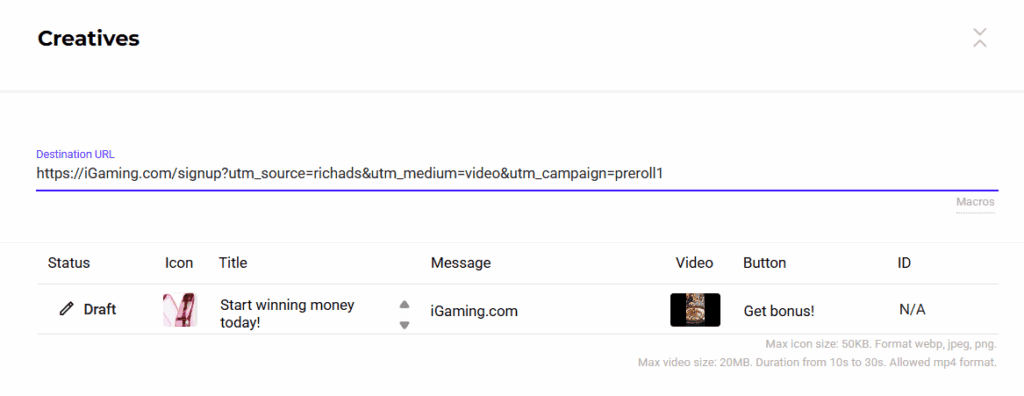
1. Prepare the right creatives
RichAds has some specs requirements:
- Length is 10–30 seconds.
- MP4 format, under 20 MB.
- Aspect ratio is up to 16:9, resolution is 1920×1080.
You can upload up to 5 video creatives per campaign, and for each, you should provide an icon, a short title, a domain, and CTA button text.
2. Select targeting
You can define your target audience through:
- GEO — country, region, city.
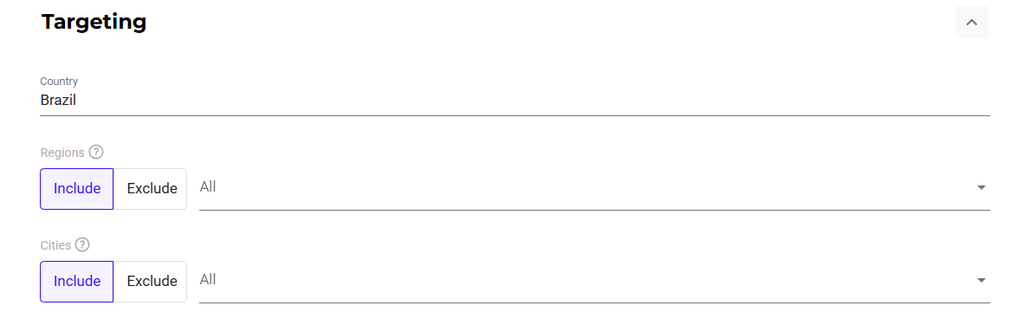
- Device and OS. We’re talking about video ads for mobile apps and games, so we recommend picking the latest Android and iOS models.
- Language. Set the language your target audience speaks.
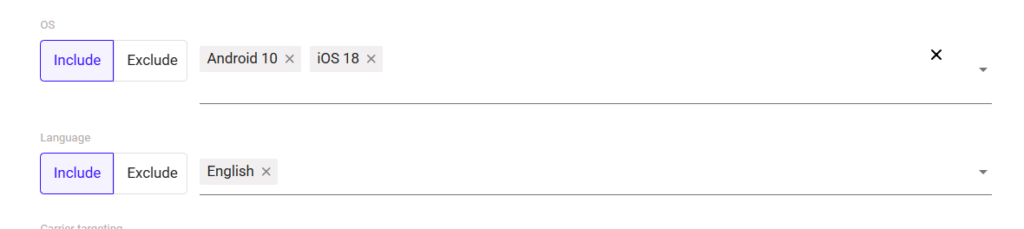
- Carrier. Useful metric for mobile-first video ads, since connection speed affects whether a video loads and plays smoothly.
- Impression capping. Limit how many times one user sees the same ad per day. To avoid ad fatigue, we recommend capping at one.

3. Set the budget and bidding
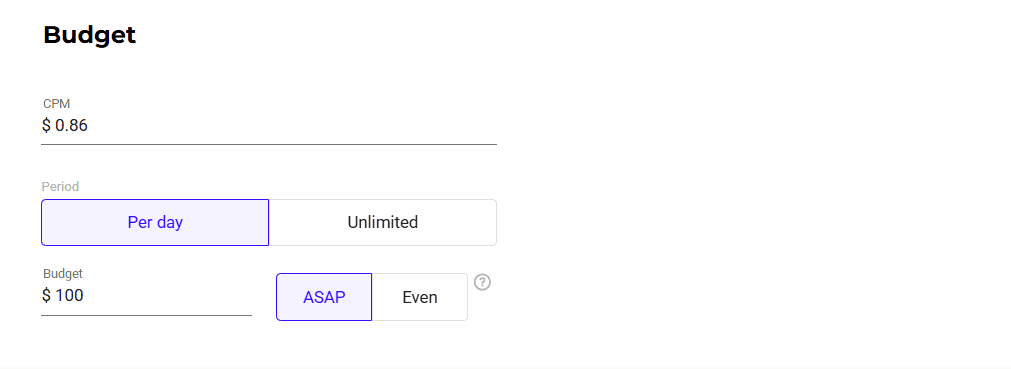
Mobile video ads at RichAds run on CPM. The platform will show you a recommended bid for your chosen GEO. Use it as a baseline, and be ready to bid up for competitive GEOs or premium placements.
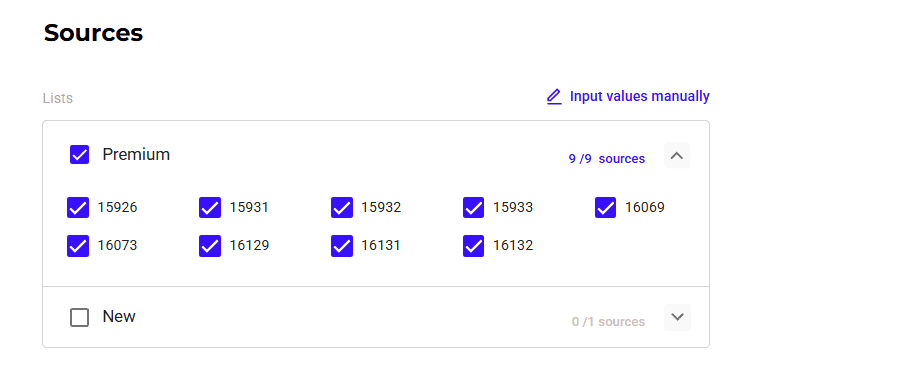
4. Choose Premium sources
Use the Premium sources option to launch on the best-performing placements that have shown strong results for similar campaigns.
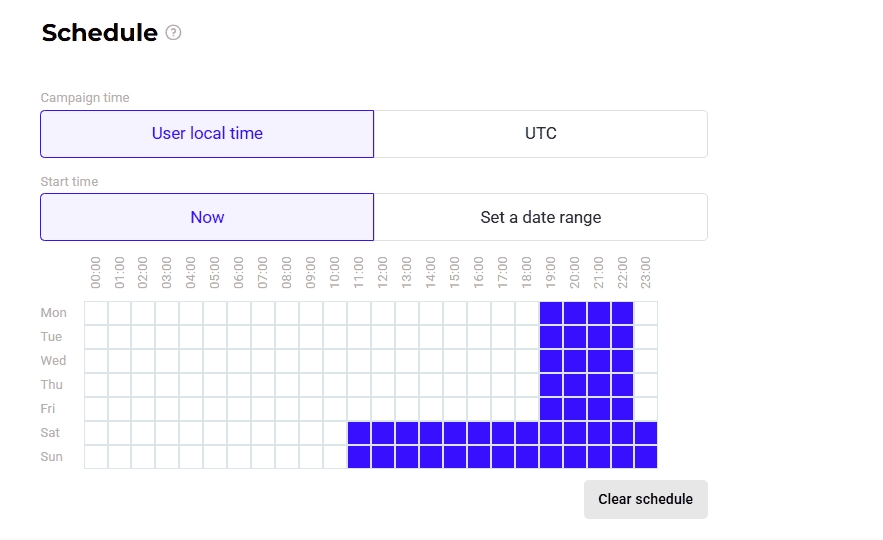
5. Set campaign schedule
For initial tests, you can launch the campaign without a specific schedule. However, if your ads are time-sensitive or you know exactly when your audience is active, you can choose specific days of the week and hours to run video ads.
6. Set up tracking and automate optimization
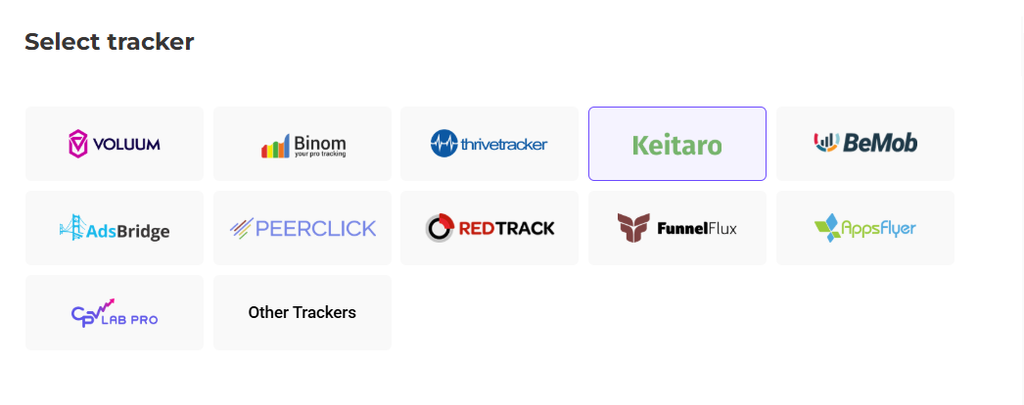
Use a tracker to see which sources, GEOs, and creatives actually drive conversions. Video traffic volumes are high, so it’s easy to waste the budget on underperforming sources if you don’t monitor video ad metrics in real time.
Once you have enough data, you can adjust bids by placement and automate routine tasks. Set rules to automatically pause underperforming creatives or sources so the budget isn’t wasted while you’re not actively watching the campaign.
You can also check out our step-by-step guide on how to launch a pre-roll video ad campaign.
Conclusion
Mobile video ads are one of the best opportunities in performance marketing right now. They deliver near-total viewability, maximum engagement, strong click-through rates, and a direct path from view to conversion.
If you haven’t tried mobile-first video ads yet, it’s really important you do so now before your competitors take advantage of them. Sign up for RichAds, choose the pre-roll video format, and launch your first campaign today. You’ll see how effective and profitable video ads can be.
What is RichAds?
Ad network for telegram ads,
high quality push and popunder ads,
domain redirect, native and display traffic source,
buy push ads at $0.005 (CPC), pop ads at $0.5 (CPM),
domain ads costs start from $1.5 (CPM), native ads — from $0.001 (CPC),
ad network offers large volumes of traffic in more than 200 geos from Tier 3 to Tier 1.

FAQ on mobile app video ads
According to the RichAds ad network’s guide, there are six formats: in-stream, interstitial, in-app, rewarded video, playable ads, and gamified video ads.
The RichAds ad network experts recommend producing 15–20-second ads. 30 seconds is the ceiling, as anything longer sees a sharp drop-off on mobile.
Rewarded video is opt-in: the user chooses to watch in exchange for an in-game reward, so completion rates run 90%.
Interstitials appear automatically at natural breaks like level transitions or screen loads without user consent, so they attract a less loyal audience and need careful frequency capping to avoid hurting retention.
CPM ranges widely by format and GEO, from around $0.05 on affiliate networks like RichAds up to $15–$40 for rewarded mobile game video ads.
GEO is usually the biggest price lever, and costs can rise by 2–3x in Tier 1 countries.
Not really, they usually work without it. A large share of mobile video is watched muted, so captions and clear on-screen visuals help carry the message. Sound should only support the ad.
According to the RichAds ad network stats, top verticals include Gambling, Betting, Dating, Nutra, E-commerce, and Gaming. Video works especially well for them because it can show a product in use and convince users to try it.










 Latest articles