



Short overview:
There are 13 main video ad types: seven in-stream, three out-stream, and three user-engagement-based. We’ll explain how each of them works and where to use it, and provide a comprehensive comparison table.
Types of video advertising: three ways to classify
Video ad types get named in many ways, and the names usually overlap, making advertising more confusing. To keep things clear, we’ll sort the types of video advertising into three categories:
- By placement — where the video shows up. In-stream ads run inside a video player. Out-stream ads run outside video content, for example, in an article, a feed, or a banner zone.
- By playback — how the ad treats the main video. Linear ads stop the content and play in its place. Non-linear ads sit on top of the content while the main video keeps playing.
- By user engagement — how the user meets the ad. Rewarded video pays the user for watching. Interstitial video opens full-screen. Native video blends into the surrounding content.
You can mix these labels into compound names, like “in-stream linear” or “out-stream native”. But ultimately, all video ads are either in-stream or out-stream, so we discuss these two categories in detail.
What is RichAds?
Ad network for telegram ads,
high quality push and popunder ads,
domain redirect, native and display traffic source,
buy push ads at $0.005 (CPC), pop ads at $0.5 (CPM),
domain ads costs start from $1.5 (CPM), native ads — from $0.001 (CPC),
ad network offers large volumes of traffic in more than 200 geos from Tier 3 to Tier 1.
In-stream video ads: types and formats
In-stream is the first group of video ad types to know. These ads run on streaming platforms and video sites where users’ primary intent is to watch video — YouTube, Twitch, Vimeo, and more.
In-stream ads require a video player, and they show up inside or next to it. The viewer is already in “watch mode”, so they won’t miss the ad.
There are three sub-categories: linear, non-linear, and companion ads. Plus, linear and non-linear ads are each divided into three more types.
Linear video ads
Linear ads take over the entire video player and play in line with the content. They pause the main video, similar to TV commercials.
This type of in-stream video ad is the most common and the one most relevant to affiliates. Usually, the ads play before the main video starts — they’re called pre-roll ads.
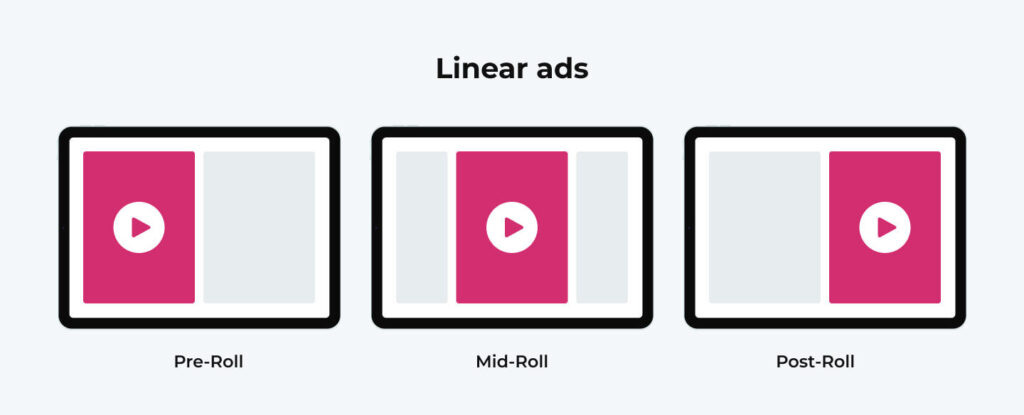
Pre-roll videos are 15 to 30 seconds long and work well for brand awareness campaigns. The viewer has to watch for at least a few seconds before getting to their intended content, so visibility is guaranteed.
There are also mid-roll and post-roll ads among linear video ads. However, they are less popular.


Non-linear streaming ads
Non-linear video ads don’t interrupt playback. They appear on top of the playing video as an overlay, letting the viewer keep watching while the ad is visible. Overlay ads are less intrusive, but they also have a lower impact.
The main non-linear formats are:
- Overlay banners — a small static or animated banner that appears at the bottom of the video frame.
- Overlay text — a text message layered on top of the video. It helps deliver a short message without blocking the screen.
- Branded canvas units (L-banners) — the video temporarily shrinks to accommodate an L-shaped banner beside it.
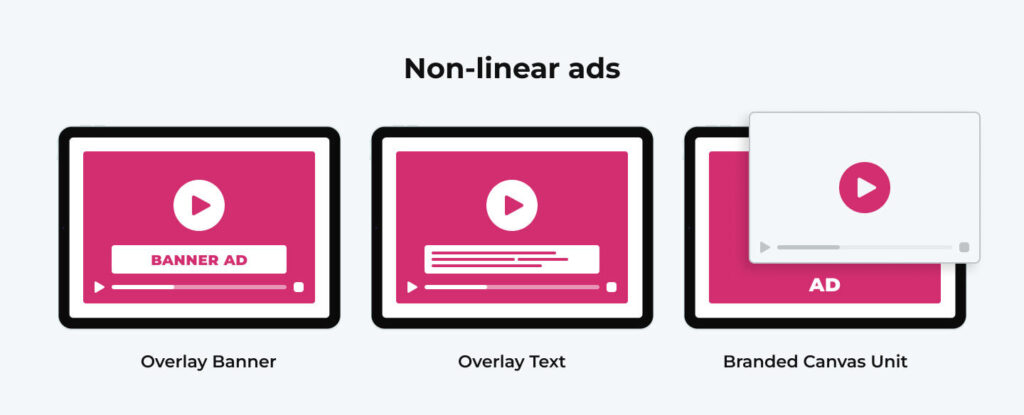
Non-linear ads are mostly used for retargeting campaigns, as they won’t convert cold traffic.

Companion ads
Companion ads run outside the video player. They can appear in the sidebar, below the video, or in the surrounding page content as image, text, or animated units.

They’re often paired with linear or non-linear in-stream ads to reinforce the message. You may have seen these on YouTube: they usually show a banner ad next to the video that matches or relates to the pre-roll video ad that just ran in the player.
What is RichAds?
Ad network for telegram ads,
high quality push and popunder ads,
domain redirect, native and display traffic source,
buy push ads at $0.005 (CPC), pop ads at $0.5 (CPM),
domain ads costs start from $1.5 (CPM), native ads — from $0.001 (CPC),
ad network offers large volumes of traffic in more than 200 geos from Tier 3 to Tier 1.
Out-stream video ad types
Out-stream ads play outside a video player, and the page does not need any video content. Advertisers can show out-stream ads in any article, blog, feed, or app.
The video usually starts automatically when at least part of the ad appears on screen, and it is muted by default.
There are three common out-stream video ad types:
- In-text (in-read). The video is placed between paragraphs of an article or in a feed. It opens as the reader scrolls down to it and pauses or collapses when the reader scrolls away.
- In-slider. The video appears in a small corner window that slides in as the user scrolls, then stays on screen or closes. It’s easy to notice, but it can also annoy users.
- In-banner. The video plays inside a standard banner slot, in a sidebar or a header unit. It needs no special page layout, so it’s the simplest out-stream video ad format to add to virtually any site.
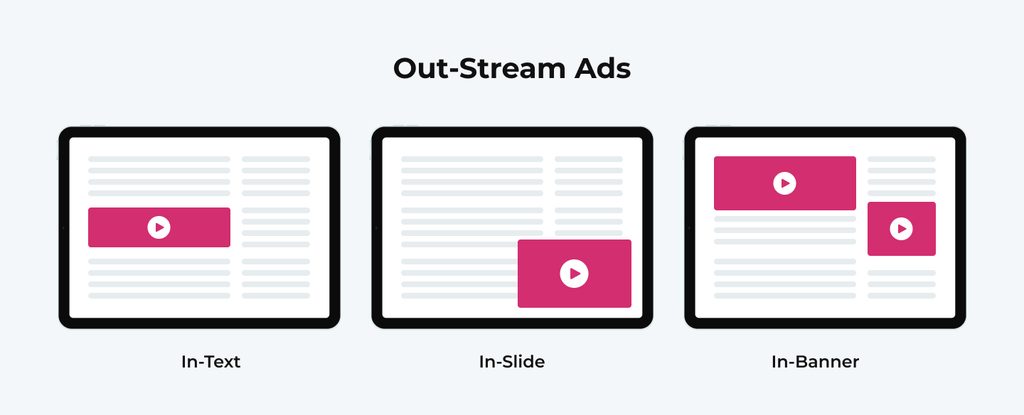
Affiliates usually use out-stream types of video advertising for cheap reach when testing many offers or GEOs. However, the quality of traffic may be questionable, and there is a high risk of misclicks.

In-stream vs out-stream: which type of video ads wins?
In-stream video ads win for most affiliate campaigns. They give higher engagement and better conversions, because the viewer is already watching a video with the sound on. But out-stream wins on price and scale, so the choice depends on your goals.
Here is the side-by-side view:
| In-stream ads | Out-stream ads | |
|---|---|---|
| Placement | Inside a video player | In text content, feeds, sidebars |
| Sound | On by default | Muted by default |
| Viewability | Very high | Low, user may scroll past |
| Engagement | High | Moderate |
| Completion rate | Up to 90% | 40-60% |
| Inventory | Requires video content | Works on any page |
| CPM | Higher | Lower |
In short, if your offer needs attention and user action, such as a sign-up or an app install, buy in-stream traffic. If you want to test fast and cheap, start with out-stream and move the winners to in-stream.
What is RichAds?
Ad network for telegram ads,
high quality push and popunder ads,
domain redirect, native and display traffic source,
buy push ads at $0.005 (CPC), pop ads at $0.5 (CPM),
domain ads costs start from $1.5 (CPM), native ads — from $0.001 (CPC),
ad network offers large volumes of traffic in more than 200 geos from Tier 3 to Tier 1.
Video ad types by user engagement
User engagement is a valuable video advertising metric, and, as we’ve already mentioned, there are three types of video ads based on how users engage with them: rewarded, interstitial, and native.
All these formats can run in-stream or out-stream, so they combine with the categories above.
Rewarded video
This type of video ad runs mostly in mobile games and apps. The user chooses to watch an ad and gets a reward, such as an extra life, in-game currency, or a feature unlock.
The completion rate of rewarded ads is very high, often 90% or more, because users agree to see the ad. That’s why you get warm leads and good-quality traffic.
However, the results depend heavily on the publisher’s game mechanics, and inventory is limited. Rewarded types of video advertising suit only app installs and mobile gaming offers.
Interstitial video
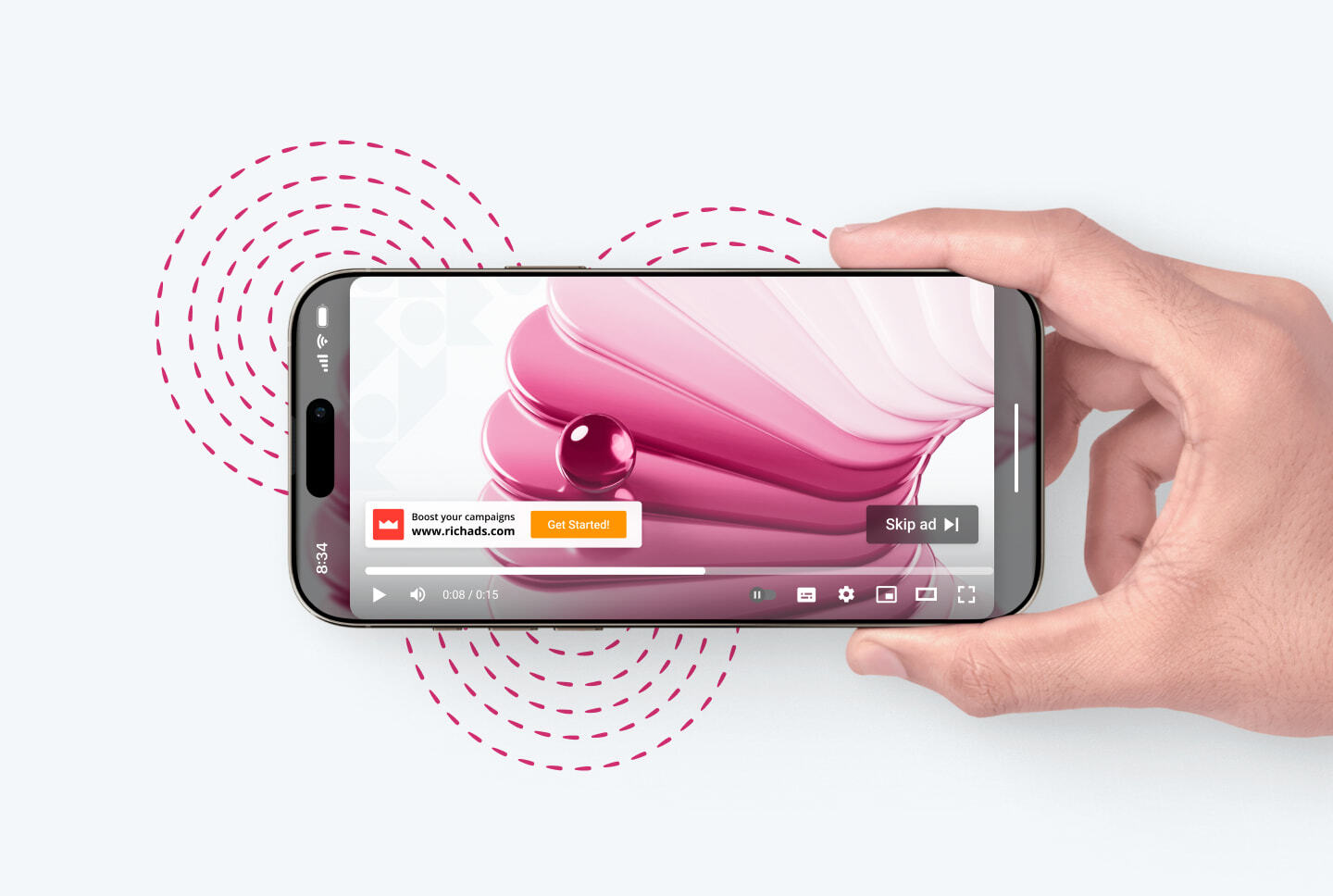
Interstitials are full-screen videos that appear at natural pauses, such as between game levels or when the user moves from one screen to another. This video ad type doesn’t need video content on the page, so you can use it on any app or website. The full-screen view makes it hard to miss, delivering great reach and maximum attention.
However, you need to cap it wisely, as interstitials may feel intrusive if you show them too often. Accidental clicks are also a risk.
Native video
Native video ads are styled to match the content around them. They usually appear in news feeds, articles, blogs, and editorial pages, where people read long-form content.
This video ad type auto-plays on scroll and doesn’t interrupt the overall experience. People trust native ads more, and banner blindness affects video less than static native formats.
Still, direct performance is lower than pre-roll ads, for example. You also need many creative variants, adapted to each placement.

Video ad types compared: which format fits your campaign?
Here’s a clear comparison table of all mentioned video ad types, so you can check which format fits your task.
| Format | Where it runs | Launch trigger | Pros | Cons |
|---|---|---|---|---|
| In-Stream | Video players, streaming services, video hosting sites | Built into the player, launches with the content | High user attention; VAST/VPAID support gives tracking and interactivity flexibility; premium format perception | Requires the publisher to have video content; higher buying cost; user can close/skip the ad |
| Pre-Roll | Start of in-stream video, before the main content | Auto-plays before playback starts | Maximum reach and forced-view; the user hasn’t gotten their content yet — high motivation to watch through and react | Annoys the user if the ad is long; high skip rate at the first opportunity; competition for the first few seconds of attention |
| Mid-Roll | Middle of long in-stream video, splits the content | Triggers at a preset pause point in the content | High completion — the user’s already invested and doesn’t want to leave | Needs long-form content (~8–10 min+); bad placement can annoy at a climactic moment |
| Post-Roll | End of in-stream video, after the content wraps | Plays after viewing finishes | Lowest buying cost; doesn’t interrupt the main viewing | Lowest completion rate — the user’s usually already gone; minimal effectiveness for performance goals |
| Overlay Banners | On top of the playing video, usually at the bottom of the frame | Appears at a set time while the video keeps playing | Doesn’t interrupt playback; low-friction format; good for retargeting | Lower impact; small and easy to ignore; weak for cold traffic |
| Overlay Text | On top of the playing video | Appears at a set time while the video keeps playing | Delivers a short message without blocking the screen; least intrusive in-stream option | Lowest impact among in-stream formats; text only, so little room for creative |
| Branded Canvas Units (L-banners) | Around the video: the video shrinks to make room for an L-shaped banner | Triggers at a set moment; the video returns to full size afterward | More visible than a plain overlay; ad and content are on screen together; good for retargeting | Changes the viewing layout, which can annoy users; needs custom creative; limited support |
| Companion Ads | Outside the player: sidebar, below the video, or page content | Shows alongside a linear or non-linear in-stream ad | Reinforces the in-stream message; stays visible after the video ends; works as image, text, or animated unit | Not a standalone format — it needs an in-stream ad to pair with; easy to overlook |
| Out-Stream | Articles, social feeds, banner zones on sites without video | Auto-plays when it enters the viewport (in-view triggering), usually on scroll | Huge available inventory (any site, not just video platforms); cheaper than in-stream; scalable reach | Usually muted by default — lower engagement; higher non-viewability risk; easy to lose among the content |
| In-Text Ads | Between paragraphs of an article or blog post | Opens as the reader scrolls to it; pauses or collapses when scrolled away | Fits long reads; the reader is already focused on the page; no video content needed | Muted by default; low viewability if the reader skips ahead; depends on article traffic quality |
| In-Slider Ads | A corner window that slides in as the user scrolls | Triggers on scroll and stays on screen or closes | Easy to notice; follows the user down the page; works on any site | Can block content and annoy users; frequency control matters; risk of accidental closes |
| In-Banner Ads | A standard banner slot, such as a sidebar or header unit | Auto-plays when the banner enters the viewport | Simple to add to any site with banner zones; no special page layout | Small space for creative; easy to lose among page elements; banner blindness |
| Rewarded Video | Mobile games and apps | Voluntary click in exchange for a reward (extra life, in-game currency, feature unlock) | Very high completion rate (often 90%+); positive ad perception — a deal, not an interruption; quality, “warm” lead | Narrow inventory (gaming apps only); doesn’t work for cold reach; depends on the publisher’s game mechanics |
| Interstitial Video | UI pauses in apps/sites (between levels, screen transitions) | Auto-shown at a natural pause in interaction | Good balance of reach and attention; full-screen format — high visibility; not tied to having video content | Can feel intrusive if triggered too often; risk of accidental clicks |
| Native Video | News feeds, recommendation blocks, content widgets | Auto-plays on scroll, styled to match surrounding content | Less banner blindness; organic placement boosts CTR; soft, non-intrusive funnel entry | Lower direct performance; needs solid creative adaptation to the placement’s style; risk of being mistaken for organic content (reputation risk) |
The table is abstract — no volumes, costs, or conversions. For concrete numbers, check out our comprehensive research on video advertising in 2026.
Conclusion
The 13 video ad types cover almost every campaign an affiliate may run. They can give you attention, cheap traffic, wide reach, or quality leads, so set your goals and pick the matching format.
In most cases, in-stream pre-roll video ads are the best solution, as they work well for both brand awareness and performance.
If you need maximum visibility and high-quality traffic, launch a pre-roll ad campaign on the RichAds ad network. The platform offers premium inventory, advanced optimization tools, and expert personalized support to help you achieve the best results.
Read the pre-roll ads guide for setup tips, and run your first test on RichAds!
What is RichAds?
Ad network for telegram ads,
high quality push and popunder ads,
domain redirect, native and display traffic source,
buy push ads at $0.005 (CPC), pop ads at $0.5 (CPM),
domain ads costs start from $1.5 (CPM), native ads — from $0.001 (CPC),
ad network offers large volumes of traffic in more than 200 geos from Tier 3 to Tier 1.

FAQ
According to the RichAds ad network blog, the main types of video ads fall into three groups:
- By placement: in-stream and out-stream.
- By playback: linear, non-linear and companion.
- By engagement: rewarded, interstitial and native.
In-stream linear ads include pre-roll, mid-roll, and post-roll. Non-linear includes overlay banner, overlay text, and L-banner. Out-stream includes in-text, in-slider, and in-banner ads.
In-stream ads run inside a video player, with sound on. Out-stream ads run outside video content — in articles, feeds, or banner zones, and are muted by default.
In-stream costs more and needs video inventory. Outstream costs less and works on any page, without a video player.
Linear ads stop the main video and play in its place, like pre-roll ads. Non-linear ads appear on top of the video as an overlay, allowing it to keep playing.
Linear ads have a greater impact and are better suited to performance campaigns. Non-linear ads are less intrusive and suit retargeting.
The choice of video ad types depends on your goal:
- In-stream ads, especially pre-roll, are the best choice for converting cold traffic. They have high attention and completion rates of up to 90% (for non-skippable).
- Out-stream and native video ads are better for cheap testing and soft funnel entry.
- Rewarded video works well for mobile gaming audiences, delivering warm traffic for app install campaigns.
The RichAds ad network experts recommend testing two or three formats and comparing CTR, CPV, and CPA before you make a decision.
Rewarded video ads give the user a reward, such as an extra life or a bonus, in return for watching the full ad. It’s the most popular type of video ads in mobile games and apps.
Rewarded video gives good results, with completion rates often 90% or higher, but the inventory is limited to gaming apps.
The RichAds ad network experts provide these ranges:
| Type of video ads | Recommended length |
|---|---|
| Linear (skippable or non-skippable) | 15 to 30 seconds |
| Non-linear overlay | A short text or banner message while the video plays |
| Out-stream (in-text, in-slider, in-banner) | 10 to 30 seconds |
| Rewarded | 15 to 30 seconds |
| Interstitial | 15 to 30 seconds |
| Native | 6 to 20 seconds |








 Latest articles